Sunday, May 20, 2012

White-backed Munia

One of the several munia (or finch) species observed quite commonly in these regions, the Whitebacked Munia is a small bird. From afar, it appears white and black, though on closer observation, one can notice that the plumage is in fact, blackish-brown and white.


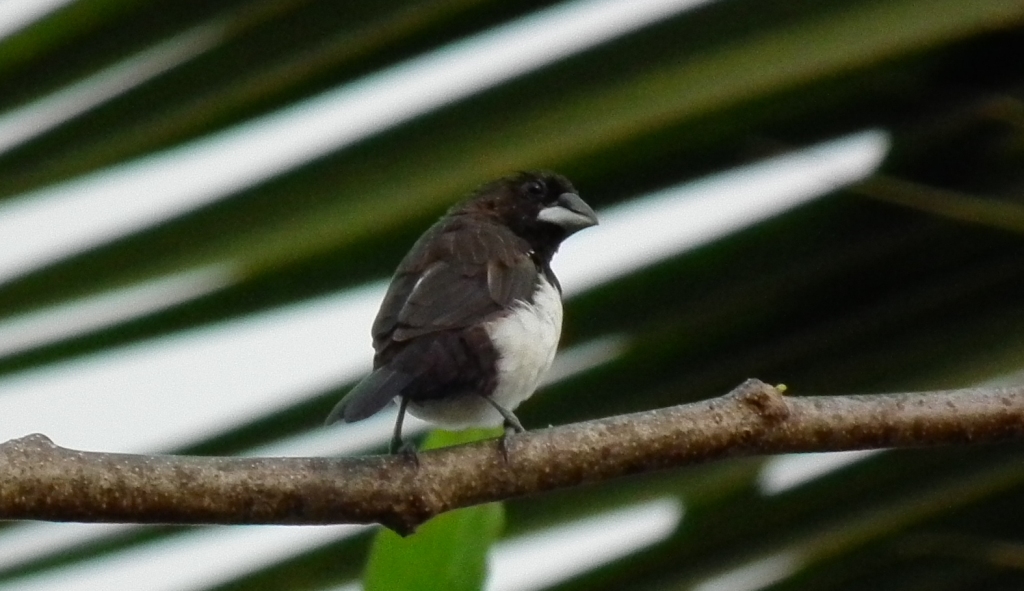
It can be identified from its blackish-brown head, neck and upper body parts, white abdomen and rump. It has a thick steel-grey bill, suitable for eating plant and grass seeds.   It frequents lightly wooded forests, near cultivation and may be observed in small flocks of 4-6 birds. It has a feeble chirping call, cheep, cheep... 

Location: Varca, Goa

Name
White-backed Munia
Alternate name(s)
White-rumped Munia
Size
Smaller than Sparrow
Occurrence
In lightly wooded areas near cultivated land
Status
Fairly common
Distinct features
Overall blackish-brown and white bird with a thick bill, white abdomen and distinct white patch on its back, short pointed tail.
Male/Female
Alike

Sunday, May 13, 2012

Elephanta Island

After a long and steep climb over the steps leading to the caves, at the place where the stalls and restaurants come to an end, there is a rough and dusty pathway which further leads to the village of Rajbunder, in the interior of the Island. From here, one can catch a glimpse of the pier where ferries from Mumbai arrive and part of the steps leading up to the caves.  I had expected the Elephanta Island to be spared of the scourge of plastic. But, that is not the case. All along this path are dumped large quantities of garbage and plastic waste, including water and soft drink bottles, plastic glasses and the like. It was the same in the vicinity of the village. 
This shows that we (Indians) are just not bothered about the environment and the damage we are causing to Mother Nature.  

As you proceed along this path, away from the noisy stalls and visitors, it becomes quieter and you can spot various bird species, like the Common Iora, Yellow-throated Sparrow, Minivet, Pariah and Brahminy Kites. We were lucky to also spot the Grey Hornbill.

The Iora has the most unique and exquisite calls of all birds, a melodious whistling tone, which words can hardly describe. You have to listen to it to really appreciate how great it sounds.
 
About a kilometer away is a small botanical park, not formally opened yet. You can however, enter the park and walk along the embankment of a pond and spot several ducks and lapwings. 


Considering that the island of 1600 residents has more than 500,000 annual visitors, and being home to a world heritage site, the Elephanta Caves, it is hoped that the Maharashtra government offers better facilities to the islanders to deal with the problems of garbage disposal, sanitation and electricity supply (although arrangements were made for providing basic solar electricity to the village).

Until that happens, it is up to the visitors to act responsibly and avoid further degradation of the island.We can do our bit by reducing usage of plastic.

Monday, May 7, 2012

Jungle Babbler

It is a raucous, myna-sized bird, brown bird, with a long tail, found in large flocks.

The flocks are very vocal and keep up a constant prattle while feeding or nesting (hence the name, babbler). They become extremely loud and aggressive at perceived threats to their nesting sites from predatory birds, cats or humans. This helps in warding off attacks by the predators. 

Its earthy brown hues enable it to easily merge into the background, as it forages among fallen leaves and branches in search of insects, hopping about in groups of 2 or more.
 
Location: Varca, Goa

Name
Jungle Babbler
Alternate name(s)
Saat bhai (Hindi) (means “seven brothers”, since they are in large flocks)
Size
Myna
Occurrence
In lightly forested areas
Status
Fairly common
Distinct features
Overall brown colored bird with a long tail, very noisy.
Male/Female
Alike

Sunday, April 29, 2012

Wagtails

There are several species of the wagtails, which are migratory visitors to our country. The Large Pied Wagtail is the largest amongst them and is as big as the bulbul (slightly larger than the sparrow). It has a white and black plumage with a long white and black tail, which is constantly wagging in an up and down motion. Of course, that’s why it is called pied (white and black in simple terms) wagtail. 
 
Its black head has a distinct white streak over the eyes, in the form of white eye-brows. White abdomen and lower parts are its other identifying features. 

 
Habits
It is often found singly, on open grassy surfaces and marshy regions near wetlands and feeds by running around in search of insects, making good use of its long slender legs on all types of surfaces. Tolerant of human presence, it may be seen in close proximity of farming activity.
 
 
Yellow Wagtail
 
Another species commonly seen alongside the pied wagtail is the smaller, Yellow Wagtail. 
Its habits are similar to that of pied wagtail; however, it keeps its distance from humans. It can be identified by its black head, olive green upper body and yellow under parts.
 
 
Location: Varca, Goa